You can know every new products be published here, and witness our growth and innovation.
Date:05-26-2026
Usage instructions
(1) Preparations before use
Specification selection: Based on the nominal cross-sectional area of the overhead insulated conductor, the outer diameter of the insulation layer, and the model of the insulator on the line, select a matching puncture-type lightning protection device to ensure that the product model is compatible with the conductor parameters and the insulator model, and avoid failure of protection or damage to the conductor due to incorrect selection; for example, when the conductor cross-sectional area is 70-120mm², the FHJ-70-120 model product can be selected; when the conductor cross-sectional area is 150-240mm², the FHJ-150-240 model product can be selected.
Equipment inspection: Check whether the appearance of the piercing-type lightning protection device is intact, without any defects such as damage, cracks, rust, etc. The piercing teeth of the piercing electrode have no deformation or wear, the insulating cover has no damage or aging, and the grounding electrode has no deformation. At the same time, check that the insulator of the line to be installed is in good condition, and the surface of the conductor has no severe rust or damage. Ensure that the installation foundation meets the requirements.
Tools and protective preparations: Prepare a torque wrench (set the torque value at 18-26 Nm), screwdriver, wire stripper (as a backup), etc. as installation tools. Operators should wear insulating gloves and insulating shoes and other protective equipment. Confirm that the operation environment is free from severe weather such as thunderstorms and strong winds to avoid safety accidents during high-altitude operations. At the same time, prepare auxiliary accessories such as fixing clips to ensure the smooth installation process.
(2) Operating Steps
Determine the installation location: In a unidirectional power supply line, install the piercing-type lightning protection device on the load side of the insulator (away from the power supply side); in a bidirectional power supply line, it is recommended to install the protection device on both sides of the insulator to ensure bidirectional lightning protection; during installation, strictly follow the requirements of the product manual to adjust the distance between the piercing electrode and the insulator (for PS15 and P15 insulators, the distance can be adjusted to 270 ± 5mm), to ensure the best discharge effect.
Fixed piercing electrode: Install the piercing electrode of the piercing-type lightning protection device onto the overhead insulated conductor. Ensure that the outer layer of the conductor is tightly against the bottom of the slot of the piercing electrode, and the piercing teeth are aligned with the insulation layer of the conductor. Use a torque wrench to alternately and symmetrically tighten the two pressure nuts, controlling the torque within the range of 18-26 Nm. Ensure that the piercing teeth penetrate the insulation layer and make close contact with the internal conductor of the conductor, while avoiding excessive force that may damage the conductor.
Install grounding electrode: Loosen the fixing nut of the line insulator, insert the grounding electrode between the insulator base and the tower crossarm, ensuring that the grounding electrode is directly below the conductors and the piercing electrode. Then, tighten the insulator fixing nut to firmly fix the grounding electrode, ensuring reliable grounding and forming a complete discharge circuit.
Install the insulating cover: Put the insulating cover over the puncture electrode, and use the fastening clips to firmly connect the insulating cover. Ensure that the insulating cover completely covers the puncture electrode, providing insulation protection. At the same time, it leaves a passage for the movement of the power frequency arc root, protecting the wire from being burned and broken.
Installation Test: After installation is completed, check that all components are securely connected, the puncture electrodes are in good contact with the wires, the insulating covers are properly installed, and the grounding is reliable. Before the onset of the thunderstorm season, recheck whether the electrodes of the protector have any burn damage and whether there are any burn marks on the surface of the insulating cover. Confirm that the product is in a normal working state.
(III) Precautions
During installation, the torque value of the torque wrench must be strictly controlled. It is necessary to ensure that the puncture teeth penetrate the insulating layer and make a tight contact with the conductor, but not to apply excessive force that may damage the wire conductor, to avoid affecting the mechanical strength and service life of the wire.
The installation location must meet the requirements. One-way power supply lines should be installed on the load side of the insulator, while for two-way power supply lines, they need to be installed on both sides of the insulator. The installation distance must strictly follow the product manual to ensure the best lightning protection effect and avoid the failure of protection due to improper installation location.
It is strictly prohibited to carry out installation, dismantling or maintenance operations during thunderstorm weather or when the wires are energized. Before conducting any work, the power supply of the lines must be cut off, and the wires must be confirmed to be de-energized. Operators must wear protective insulating equipment properly to prevent accidents such as electric shock and arc burns.
Regular maintenance checks should be conducted. A comprehensive inspection should be carried out before each thunderstorm season. Special attention should be paid to checking for any burn damage, rusting of the puncture electrodes and grounding electrodes, any damage or aging of the insulating covers, and any loosening at the connection points. Any problems found should be promptly replaced or repaired to ensure the normal operation of the product.
The product should be stored in a dry, ventilated, and cool environment, avoiding high temperatures, humidity, direct sunlight, and exposure to corrosive gases. It is necessary to prevent insulation aging and electrode rusting. Different specifications of the product should be stored separately, clearly labeled, and used correctly to avoid misuse.
When replacing the product, a piercing-type lightning protection device with the same specification as the original one should be selected. After the replacement, reinstallation and testing are required to confirm reliable grounding and good contact, before the line can be restored to normal operation.
IV. Application Scenarios
The piercing-type lightning protection device, with its advantages of piercing installation, no need to strip wires, reliable protection, and economic cost, is mainly applied to lightning protection of 10kV and below overhead insulated lines. It is particularly suitable for solving the problem of lightning strike and breakage of overhead insulated conductors. The core application scenarios are as follows:
(1) Rural distribution network line scenarios
(2) Urban and industrial park distribution network scenarios
(3) Outdoor public facility line scenarios
(4) Overhead insulated line renovation scenarios
(5) Bidirectional power supply and special line scenarios.
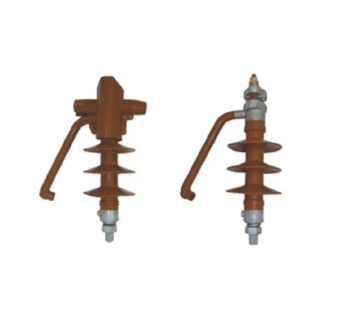
V.Product advantages
The piercing-type lightning protection device is a new core equipment for lightning protection of overhead insulated lines. It precisely addresses many drawbacks of traditional lightning protection measures. Its core advantage lies in the fact that it does not require stripping the insulation layer of the conductor and is easy to install by piercing. It not only ensures the mechanical strength and sealing performance of the conductor, but also achieves reliable lightning protection. The product has the characteristics of precise protection, wide adaptability, economic cost, simple maintenance, and long service life. It can effectively resist the hazards caused by direct lightning strikes and induced lightning strikes, avoid the breakage of overhead insulated conductors due to lightning strikes, and significantly reduce the operation and maintenance costs and the frequency of faults of the lines. Whether it is rural distribution networks, urban and industrial park distribution networks, or outdoor public facility lines and old line renovations, the piercing-type lightning protection device can stably perform lightning protection functions. It safeguards the safe and stable operation of 10kV and below overhead insulated lines. It is an ideal choice for lightning protection renovation of distribution networks.


Address:No.27, Binhai South 3 road, Yueqing Economic Development Zone, Wenzhou City,Zhejiang Province,China.