You can know every new products be published here, and witness our growth and innovation.
Date:11-17-2026
Earlier this month we took a call from a customer in the Middle East who looks after a dozen pad-mounted transformers feeding a residential district. Summer peak load is his least favorite season — not because faults happen, but because of what follows. On an oil-filled transformer, the old way of dealing with a blown internal fuse meant draining oil, opening the tank, swapping the part. Getting one unit back before sunrise counted as a good night.
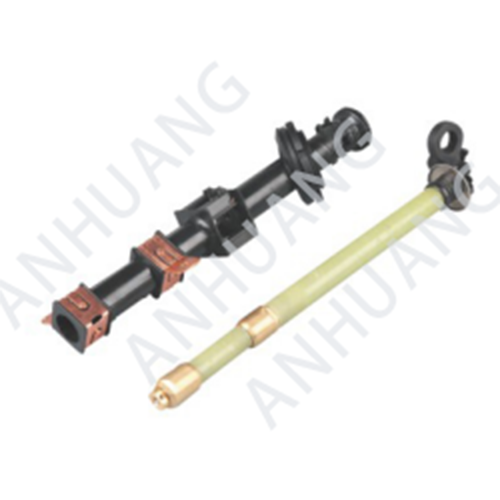
He eventually switched to the Bay-O-Net Assembly we build. This article is about why such a small component deserves its own story.
Bayonet-style fuses have lived inside oil-immersed transformers for decades, and nobody in this industry is unfamiliar with them. But “used for years” and “used correctly” are two different things. The problems we see most often in the field are not product failures at all — they’re selection mistakes. A holder gets ordered because the ampere figure matches. A backup fuse gets thrown in without much thought. Then either nothing trips when an overload drags on, or a minor fault burns out the backup device and doubles the outage bill.
So we’d put it this way: we’re not really selling a Bay-O-Net. We’re trying to talk customers into thinking the whole protection set through.
The construction of a Bay-O-Net Assembly is simple to describe. A bayonet holder seats into the tank wall or the cover; the replaceable link inside sits directly in the insulating oil. Two practical benefits follow.
First, fault current is broken inside the sealed tank — no external arc, no exposed live parts in front of the operator. Second, refilling requires no oil handling: pull the holder out, drop in a fresh link, push it back, re-energize. A practiced lineman finishes the whole job in about twenty minutes. That Middle Eastern customer later told us their average restoration time dropped from roughly four hours to around forty minutes. The holder is most of that difference.
Inside the barrel, several link personalities are available: a straightforward current-responsive type, a dual-sensing type that watches oil temperature alongside current, and a dual-element version that separates thermal tracking from fast fault response. Which one belongs in a given transformer depends on what that machine fears more — slow overloads or sudden short circuits. There is no universal answer, and anyone who tells you otherwise hasn’t read your nameplate.
Here is the part most buyers underestimate. A Bay-O-Net takes care of overloads and modest fault currents; the heavy short circuits belong to a current-limiting backup fuse (the ELSP type) or a MagnX interrupter mounted beside it in the tank. Each device stays in its own lane. That pairing is also why utilities have made this the default protection scheme on single- and three-phase distribution units alike.
Pairing is not guesswork. Transformer kVA, primary voltage, winding connection, and the fault level at the installation point — those four numbers decide which link matches which backup fuse. We generally ask customers to send all four with the first enquiry. It saves everyone a week of emails.
Three voltage classes are in regular production: 8.3 kV, 15.5 kV and 23 kV. Single-phase breaking capacity tops out at 3,500 A on the 8.3 kV class in sidewall mounting, holds 2,500 A at 15.5 kV, and 1,000 A at 23 kV. Continuous thermal ratings run 160 A, 150 A and 80 A respectively. On insulation, every unit passes a 150 kV lightning impulse test and a 50 kV one-minute power-frequency test before packing. The bread-and-butter configuration — 50 Hz, 15.5 kV, 140 A — lands squarely in the mainstream of the global distribution market.
Body dimensions follow standard tank openings, with sidewall and cover-mount versions both stocked, so OEMs rarely need to touch their tank drawings to adopt the scheme. Each assembly ships with its installation sheet and factory certificate, which matters more than it sounds when export inspections come around.
In the fuse business, the easiest sentence to write is “reliable quality, excellent safety.” The hardest question to answer is a customer asking “why should I trust you?” Our answer: send us the transformer nameplate data and the fault level at your site, and what comes back is not just a price list. You get a proposed link type, the matching backup fuse, and the curve basis behind the recommendation. And if the pairing you had in mind is wrong, we’ll say so — even when that costs us the order.
For samples, catalogs or a project quotation on the Bay-O-Net Assembly, contact the ANHUANG sales team directly. Repeat orders move on short lead times, and non-standard ratings are open for discussion on volume programs.
ANHUANG manufactures medium-voltage protection components — fuse holders, replaceable links, current-limiting fuses and transformer accessories — for transformer factories, panel builders and utilities in export markets.


Address:No.27, Binhai South 3 road, Yueqing Economic Development Zone, Wenzhou City,Zhejiang Province,China.