You can know every new products be published here, and witness our growth and innovation.
Date:11-13-2026
Meeting equipment specifications does not guarantee stable field operation.
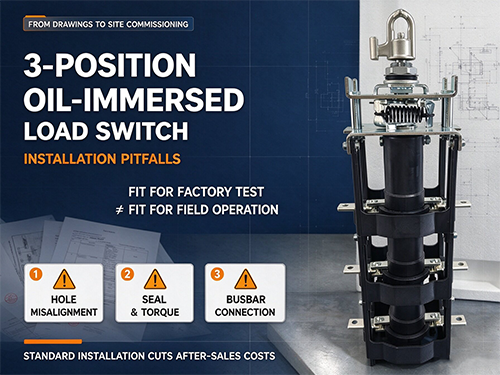
Many overseas panel builders and EPC contractors have faced this scenario: a transformer load break switch passes every factory acceptance test, yet once it reaches the job site and is energized during commissioning, problems appear — mechanism jamming, seal leakage, misaligned position indicators.
Excluding inherent product defects, most of these failures trace back to non-standard field installation. The risk is higher on overseas projects: local fitters are often unfamiliar with Chinese-built switchgear and apply installation routines from European or American equivalents — which frequently leads to mistakes.
Since our BFY3R3 three-station oil-immersed load switch entered overseas markets, our technical team has compiled the most frequently reported installation issues. This article shares them with overseas panel builders, transformer manufacturers, and engineering partners — so you can avoid the same pitfalls.
The switch flange comes with four sets of pre-drilled M10 mounting holes, designed to match Φ34 openings on the transformer tank. On many sites, installers force bolts into slightly offset holes and tighten them hard to pull the unit into position.
This twists and warps the mounting plate. Once deformed, the shaft center of the internal moving contact shifts — subsequent operations result in mechanism sticking, and in severe cases, complete failure of the transformer load break switch to operate.
Standard requirement: If hole positions do not line up, rework the openings first. Never use bolt tension to pull components into alignment.
The unit ships with a complete sealing assembly: fixed sleeves, sealing gaskets, and compression washers. Two bad practices are common on overseas sites:
Under-tightening
— bolts left too loose cause transformer oil leakage in service.
Over-tightening
— excess torque crushes the gasket. The damage may not show immediately, but oil seeps out gradually after repeated high-temperature cycling.
The instruction manual specifies torque values for every fastener. Site crews must follow these figures strictly — do not rely on installer “feel.”
Undersized or poorly aligned busbars pull the fixed contact terminal block sideways and displace the contacts. The switch may still close after wiring, but laterally stressed contacts develop rising contact resistance under continuous load — creating a serious overheating hazard inside the transformer.
After finishing busbar connections, do not hand over the equipment right away. Manually open and close the three-station oil-immersed load switch several times, and verify that the position indication matches the operating handle reading.
For overseas orders, our technical team provides English installation drawings and dimension drawings with every shipment, plus installation training videos for site crews.
We recommend that OEM and containerized equipment exporters carry out pre-assembly simulation in-house before shipment: verify tank cutout dimensions and bolt specifications in advance, rather than leaving problems to be fixed on overseas job sites.
Equipment reliability relies half on manufacturing quality and half on standardized installation. Proper pre-shipment verification can drastically reduce after-sales costs for overseas projects — and keep your transformer load break switch performing exactly as it did in the factory test bay.
Q: What should I check before installing a transformer load break switch on site? A: Verify that tank cutout dimensions and mounting hole positions match the supplied dimension drawings. Rework misaligned openings before mounting — never force bolts.
Q: Why does the operating mechanism jam after installation? A: In most reported cases, the mounting plate was warped by forced bolt tightening, shifting the moving contact shaft center. Re-check plate flatness and hole alignment.
Q: How do I prevent oil leakage at the switch flange? A: Use the complete supplied sealing assembly and tighten all fasteners to the torque values specified in the manual. Both under- and over-tightening cause leaks.
Q: What is the final step before energizing? A: Operate the switch manually through all three positions several times and confirm the position indicator matches the handle reading before handover.
Looking for a reliable three-station oil-immersed load switch for your transformer project? [Contact our technical team] for drawings, pricing, and pre-shipment verification support.


Address:No.27, Binhai South 3 road, Yueqing Economic Development Zone, Wenzhou City,Zhejiang Province,China.