You can know every new products be published here, and witness our growth and innovation.
Date:08-05-2026
Combined transformers operating in distribution networks face dual threats from lightning strikes and switching operations. A recent technical communication from industry specialists revisits the overvoltage protection strategy for such equipment, with particular emphasis on the high-voltage side configuration and the rigorous parameterization of metal-oxide surge arresters.
The protection architecture on the high-voltage terminal conventionally integrates three components: a load switch, a current-limiting fuse, and an expulsion fuse. Each element serves a distinct fault-current range. The current-limiting type interrupts severe short-circuit currents, whereas the expulsion type responds to moderate overcurrent conditions. This tiered arrangement ensures both economic efficiency and operational simplicity.
To mitigate through-fault overvoltages—specifically those originating from the low-voltage side and propagating upward—the expert panel advocates a dual-arrester series configuration. This full-range protection scheme effectively shields terminal transformers against both lightning-induced transients and switching surges. A critical safety note is that imported arrester models must be validated against Chinese grid insulation coordination standards before deployment.
Key Parameter Specifications
Four mandatory parameters govern arrester selection:
1. Rated Voltage (Un)
The rated voltage defines the maximum permissible RMS power-frequency voltage applicable across the arrester terminals. The safety criterion is:
Un ≥ 1.1 × K × Um (kV)
where K = 1.3 (fault-clearing time coefficient) and Um denotes the system’s maximum operating voltage.
2. Continuous Operating Voltage (Uc)
Uc represents the RMS power-frequency voltage that can be permanently sustained across the arrester terminals without degradation. The specification requires:
Uc ≥ 0.8 Um
This ensures the arrester remains stable under normal grid conditions without premature conduction.
3. Nominal Discharge Current (In)
This is the standardized peak current used to classify arrester energy-handling capability. For distribution-class arresters, In = 5 kA is the recommended rating.
4. Residual Voltage (Ures) and V-A Characteristics
Ures is the peak terminal voltage measured when the specified discharge current flows through the arrester. To prevent unwanted conduction during power-frequency overvoltage events exceeding Uc, the arrester’s resistance must decrease sharply once the voltage surpasses the reference threshold Uref. Additionally, the ratio of residual voltage at nominal discharge current to the lightning impulse protective level must remain ≤ 1.15.
For 5 kA-class distribution arresters, the 2 ms square-wave current capacity is a decisive selection factor. Although the prevailing standard mandates a 75 A carrying capacity—well in excess of overhead line requirements—the actual value must be calibrated based on system parameters, cable characteristics, and local lightning density.
Synthesizing the requirements of GB11032-2000, the following minimum thresholds apply for arresters intended for domestic grid service:
| Parameter | Minimum Requirement |
| Power Frequency Reference Voltage | > 15 kV |
| Continuous Operating Voltage | > 12 kV |
| Nominal Discharge Current | > 5 kA |
| 2 ms Square-Wave Current Capacity | ≥ 50 kA |
| Lightning Impulse Residual Voltage | ≤ 50 kV |
Practical Implications
A conservative rating (over-specification) shortens service life through excessive energy dissipation, while an under-rated arrester fails to protect the transformer. The selection process therefore demands a balanced approach. For imported products, full compliance with Chinese insulation coordination requirements is non-negotiable—improper parameter matching introduces latent safety hazards that may compromise the entire protection scheme.
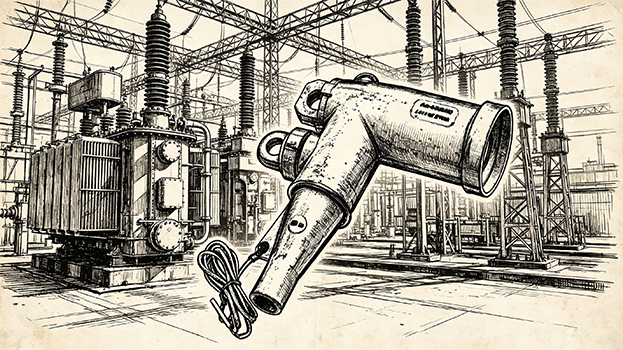
Relevant technical details are sourced from the paper Application of Elbow-Type Metal Oxide Surge Arresters in Combined Transformers by Tang Yubo & Wang Tongzhi.


Address:No.27, Binhai South 3 road, Yueqing Economic Development Zone, Wenzhou City,Zhejiang Province,China.