You can know every new products be published here, and witness our growth and innovation.
Date:11-06-2026
Last year, a utility customer in Southeast Asia sent us photos of a failed distribution transformer. The cause wasn’t the windings or the core — it was a low voltage bushing that had overheated at the terminal connection after less than two years in service. The transformer itself was worth twenty times the price of that bushing.
Stories like this are more common than most buyers expect. A low voltage bushing is one of the cheapest components on a transformer, yet it carries the full output current and sits right at the boundary between oil and air — two environments that punish weak materials in different ways. Choosing the right one deserves more attention than it usually gets in a purchase order.
The first question any engineer should ask is simple: how much current will actually flow through this bushing on the hottest day of the year, at full load? We regularly see spec sheets where the bushing rating exactly matches the transformer rating, with zero headroom. That’s asking for trouble.
For distribution transformers, our low voltage bushing range runs from 630A up to 2000A — 630A, 1000A, 1600A, and 2000A as standard. If your transformer sits at 900A continuous, don’t buy the 1000A bushing and hope for the best. Go one step up. The price difference is trivial compared to a field failure.
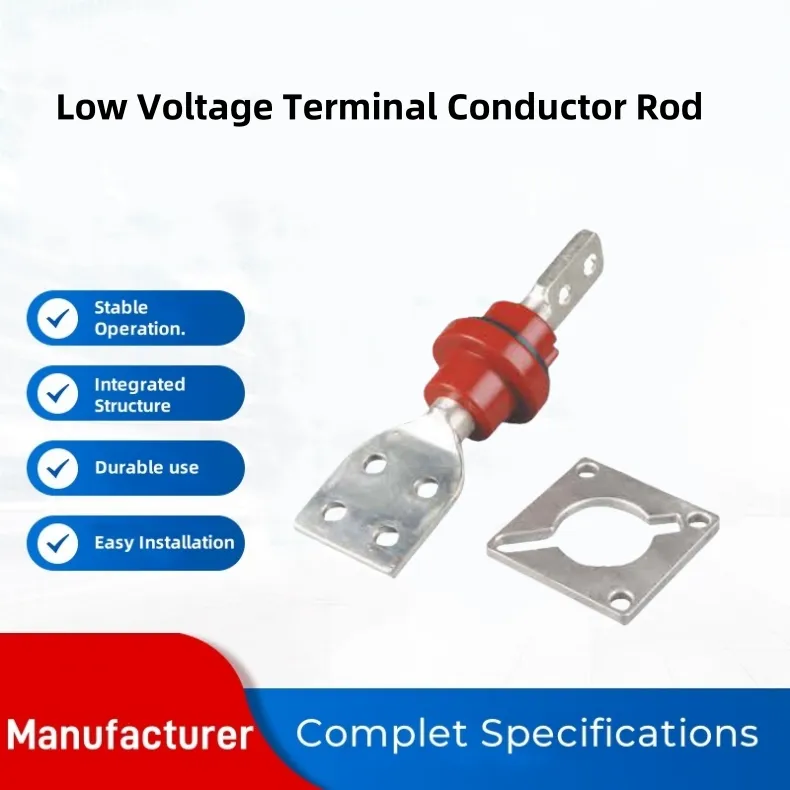
Porcelain has served the industry for a century, but on the low voltage side, epoxy resin has largely taken over — and for good reason. Our bushings are cast in high dielectric strength Bis-A epoxy, which shrugs off the thermal cycling that cracks porcelain glaze over time. Combined with an aluminum body, the assembly is light, stable at high temperature, and far more forgiving during transport and installation.
Inside, the conductor does the real work. We use tin-plated electrolytic copper as standard — the tin layer isn’t cosmetic; it’s what keeps contact resistance low after years of oxidation exposure. Some suppliers quietly substitute brass to cut cost. Ask the question.
Most bushing failures we’ve analyzed started at a connection, not in the insulation body. That’s why the terminal design deserves a hard look. On the air side, our bushings come with threaded studs, inline holes, or brazed spade terminals — the square body with a single-hole terminal gives installers a flat, stable surface that won’t rotate or loosen under vibration. On the oil side, the contact surface is machined flat, and the tapered gasket seat compresses evenly when the external clamping ring is torqued down. These details sound minor until you’re the one chasing an oil leak at a substation two hours from anywhere.
ISO9001, ISO14001, OHSAS18001 — any serious manufacturer should hold these, and we do. But certificates tell you a factory has a system; they don’t tell you whether the bushing in your hand was actually tested. Ours are. Every finished low voltage bushing goes through 100% inspection before packing, not sampling. Ask any supplier point-blank whether they test every piece or every batch. The pause before the answer is informative.
Finally, the two questions procurement teams actually call us about. Can you match our drawing? Yes — we run OEM and ODM projects constantly, from full custom designs to minor tweaks like a non-standard stud length. And how fast? Off-season, we ship within 15 workdays; in peak season, plan on a month. Anyone promising faster during peak season is either guessing or sitting on old stock.
The transformer on that Southeast Asian site failed because someone treated the low voltage bushing as a commodity line item. It isn’t. Match the current rating with margin, insist on epoxy and tin-plated copper, examine the terminals, demand 100% testing — and work with people who answer technical questions without passing you to a sales brochure.
If you have a drawing or a spec sheet on your desk right now, send it over. Our engineers will tell you honestly whether our bushing fits — and what we’d change if it were our transformer.


Address:No.27, Binhai South 3 road, Yueqing Economic Development Zone, Wenzhou City,Zhejiang Province,China.