You can know every new products be published here, and witness our growth and innovation.
Date:11-03-2026
As the pace of global distribution network reliability upgrades accelerates, market demand for dual-supply configurations continues to grow. In many developing countries, where grid power supply remains unstable, dual-supply distribution schemes with mutual backup are being widely adopted. When one supply fails, a load switch can quickly transfer the load to the other supply, effectively shortening outage duration. In projects involving combined transformers and box-type substations, the oil-immersed three-position load switch is the core device that performs this function. Compared with vacuum and gas-insulated switches, the oil-immersed solution offers cost advantages and is more tolerant of humid and dusty environments. It is well suited for outdoor and underground transformer installations and has clear application advantages in Southeast Asia, Africa, and Latin America. However, Chinese-made equipment still faces multiple practical obstacles in overseas market entry.
1. Strong product advantages, but real market access barriers overseas
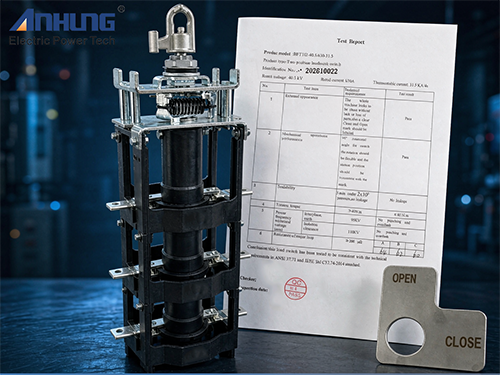
From a product performance perspective, our BFY3R3 series oil-immersed three-position load switches cover a voltage range of 15 to 38 kV and are compatible with both 50 Hz and 60 Hz grids. Key indicators such as mechanical life, short-circuit withstand capability, and loop resistance are benchmarked against internationally mainstream products. The switch adopts a side-wall embedded structure to fit compact combined transformers, and electric operating mechanisms and underground versions are available as options.
However, several challenges lie ahead for overseas expansion. First, differences in understanding of standards are the primary barrier. Some overseas customers are accustomed to the installation interface specifications of European and American brands. Even when electrical parameters are identical, minor differences in flange dimensions or locating pin positions may make direct replacement of existing equipment impossible, requiring repeated confirmation of installation drawings at an early stage.
Second, differences in on-site operation and maintenance habits cannot be ignored. Many overseas electricians are not familiar with the operating logic of the three-position mechanism. If the handle is not turned through the 90° positions, or if the limit plate is not switched correctly, the spring-charging mechanism may malfunction.
Third, storage and transportation conditions pose a potential risk to equipment performance. Long-term storage requires a dry, dust-free environment. But warehouses at some overseas ports are humid. If packaging and protective measures are inadequate, the metallic parts of the switch may corrode, and the equipment may fail as soon as it reaches the project site.
2. Corporate strategy: how to capture overseas market opportunities
To export this product effectively, companies should not confine themselves to sales alone. First, the front-end export process should fully communicate installation dimensions, operating requirements, and storage conditions to customers, rather than simply supplying electrical parameter sheets. Second, moderate customization of interface dimensions should be offered based on the needs of customers in different regions, so as to improve compatibility with local transformer enclosures. Third, technical documentation in foreign languages should be improved, with installation prohibitions and key operating points clearly highlighted, and supplemented with drawings and schematic diagrams to reduce the comprehension burden on overseas field personnel.
The global buildout of distribution networks is creating significant market headroom, but competition is equally fierce. Only by delivering on product performance, interface adaptability, and technical services can Chinese electrical equipment establish a solid foothold overseas. Going forward, our company will continue to track feedback from overseas projects, refine its product and support systems, and seize the market window offered by the upgrade of dual-power distribution networks.


Address:No.27, Binhai South 3 road, Yueqing Economic Development Zone, Wenzhou City,Zhejiang Province,China.