You can know every new products be published here, and witness our growth and innovation.
Date:11-12-2026
Pick the wrong back-up fuse and you’ll find out the hard way — usually when a transformer fault turns into a tank rupture, an oil fire, or a warranty claim nobody wants to touch. Selecting the right current limiting back-up fuse is not complicated, but it does require understanding what this device actually does, and just as importantly, what it doesn’t do.
A back-up fuse never works alone
This is the first thing buyers get wrong. A back-up current limiting fuse is built to interrupt high fault currents — and only high fault currents. It has a rated minimum interrupting current, and below that threshold it cannot safely clear a fault on its own. That’s why it always sits in series with a low-current protection device, typically a Bay-O-Net fuse or an expulsion-type interrupter inside the transformer tank.
The two devices split the work. The Bay-O-Net handles overloads and low-magnitude faults — the everyday stuff. The current limiting fuse stays silent until a serious short circuit hits, then clears it in a fraction of a cycle, limiting both the peak let-through current and the I²t energy that would otherwise tear into the transformer windings. This “dual-fuse protection” scheme has become the standard approach in pad-mounted transformer design across North America and beyond.
General-purpose, full-range, or back-up?
Before you order anything, know which category you’re actually buying. A general-purpose current limiting fuse safely interrupts everything from its one-hour melting current up to its maximum rating. A full-range fuse goes further, clearing any current that can melt its element. A back-up fuse does neither — its range starts at a defined minimum interrupting current that must be coordinated with the companion low-current device. If your application has no downstream or series protection for low-current faults, a back-up fuse is the wrong choice, full stop.
Four specs that matter on the datasheet
Voltage rating. Match it to the system, with margin. A 15.5 kV fuse is the workhorse rating for most distribution transformers in the 13.2–14.4 kV class.
Maximum interrupting current. For the XRNT5-15.5 series, this figure is 50,000 A rms symmetrical — enough for the fault levels seen at most distribution substations. Check the available fault current at your installation point; the fuse rating must exceed it.
Continuous current rating. Back-up fuses in this class typically run from 31.5 A up to 300 A, with higher ratings sometimes achieved by paralleling two fuses. Size it to the transformer, not the cable.
Minimum interrupting current and coordination. This is where coordination is won or lost. The fuse’s minimum interrupting current must overlap properly with the maximum clearing range of the Bay-O-Net or interrupter paired with it. Get the time-current curves from your supplier and plot them together. If there’s a gap between the two curves, faults in that gap have no protection at all.
Ambient and mounting conditions are not fine print
Rated performance assumes a conventional mounting in a 25°C ambient. Inside a transformer tank, oil temperature runs hotter — often much hotter. Elevated ambient temperatures shift melting times earlier, and over long periods, overload currents beyond the safe overload curves can thermally damage an E-rated element without ever blowing it. Derating is not optional in oil-immersed applications; ask the manufacturer for their oil-application curves, not just the free-air data.
A quick word on sourcing
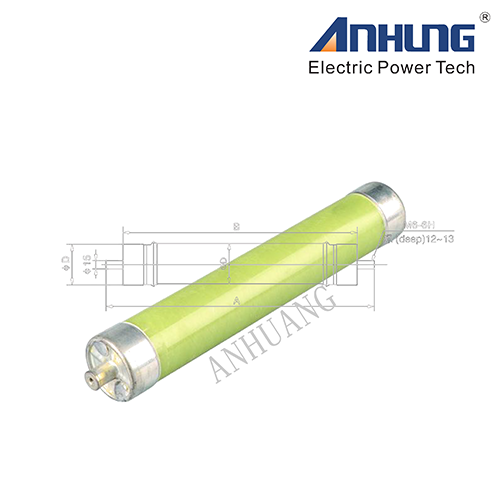
For OEMs and utilities buying in volume, consistency between batches matters as much as the datasheet. Ask potential suppliers for type test reports against IEC 60282-1, sample TCC curves for coordination studies, and dimensional drawings — the XRNT5-15.5, for instance, runs from 248 mm to 599 mm in length depending on the ampere rating, and tank space is never as generous as the drawing suggests.
The bottom line: a back-up current limiting fuse is a specialist. Pair it correctly, coordinate the curves, respect the ambient conditions, and it will sit quietly in the tank for decades — doing nothing at all, until the one moment it has to do everything.


Address:No.27, Binhai South 3 road, Yueqing Economic Development Zone, Wenzhou City,Zhejiang Province,China.