You can know every new products be published here, and witness our growth and innovation.
Date:04-09-2026
Epoxy resin insulatorsare a crucial insulating component widely used in medium-voltage switch cabinets (such as KYN28, XGN15, etc.) and ring main units. They utilize the excellent electrical properties and mechanical strength of epoxy resin to achieve reliable electrical isolation and mechanical support within the compact cabinet space.
Here is a detailed introduction aboutindoor epoxy resin insulators:
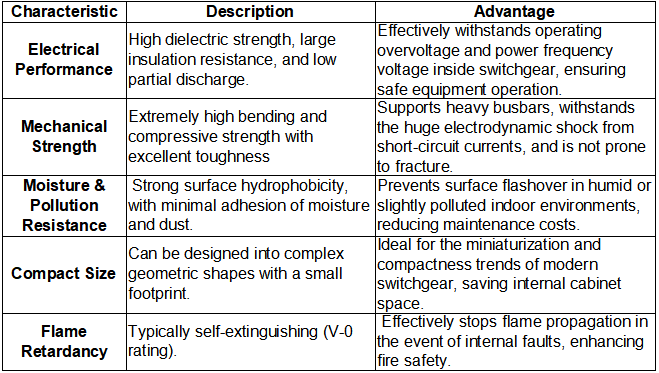
II. Main Structural Forms
In switch cabinets, epoxy resin insulators typically exist in the following forms:
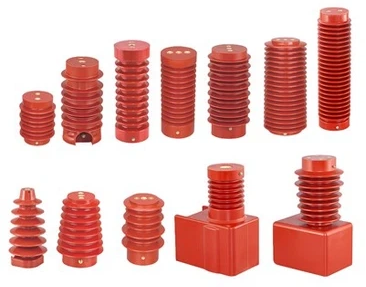
1. Pillar Insulator
Function: Used to support and fix busbars, static contacts, or the body of circuit breakers.
Characteristics: Mostly cylindrical or with umbrella skirts, the bottom has installation holes, and the top has threaded holes or inserts for fixing conductors.
2. Through-wall bushing
Function: Used for the busbar to pass through the partition (such as gas chamber partition or the side wall of the cabinet) of the switch cabinet, achieving electrical connection while ensuring airtightness.
Features: Cylindrical structure, with a conductor channel in the center, and flange discs at both ends for sealing and fixation.
3. Insulation Barrier/Insulation Tube
Function: Acts as an isolation barrier between phases or between phase and ground, preventing arc short-circuiting.
Features: Plate-shaped or tube-shaped, usually without metal inserts, solely used as an insulating medium.
III. Common Faults and Maintenance
1.Although epoxy resin has excellent properties, it is still necessary to pay attention to the following issues during long-term operation:
Surface corona discharge: If the surface is heavily covered with dust and damp, corona discharge may still occur. Regular cleaning is necessary or ensure that the environment inside the cabinet is dry.
2. Internal defects: If there are bubbles or impurities during the manufacturing process, local discharge will occur under the influence of the electric field. Over time, this accumulation can lead to insulation breakdown.
3. Mechanical damage: If subjected to impact during installation or transportation, it may cause internal cracks, thereby reducing the insulation strength.
IV. Selection Considerations
When choosingindoor epoxy resin insulators, the following parameters must be carefully confirmed:
Rated Voltage: It must match the rated voltage level of the switch cabinet (such as 12kV, 24kV).
Coulomb distance: Select an appropriate coulomb distance based on the dirtiness level of the installation environment (typically 0 level or I level for indoor applications).
Mechanical load: Based on the weight of the supporting conductor and the magnitude of the short-circuit current, select the model with sufficient bending strength.
Installation dimensions: Ensure that the installation hole spacing, thread specifications, etc. match the structure of the cabinet.


Address:No.27, Binhai South 3 road, Yueqing Economic Development Zone, Wenzhou City,Zhejiang Province,China.