You can know every new products be published here, and witness our growth and innovation.
Date:11-23-2026
Our ANSI porcelain bushing line — the 15KV through 38KV, 55A family — is one of those products that looks simple on a catalog page and turns out to have a surprising number of ways to go wrong in a purchase order. Having dealt with the full range of those ways over the years, it seemed worth putting a few honest notes in writing: what this product actually does, where buyers most often get tripped up, and what to send us if you want a fast, accurate quotation.
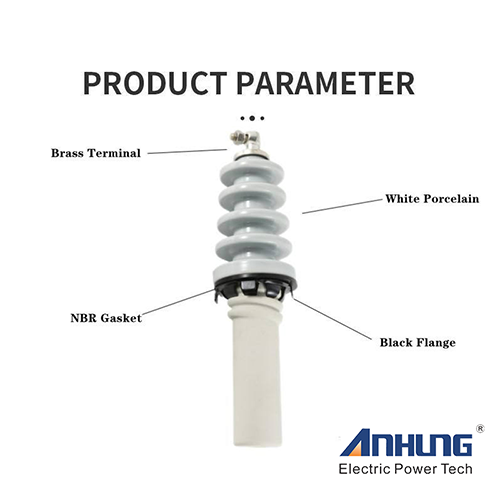
First, a quick word for anyone reading this from a purchasing desk rather than an engineering one. A transformer porcelain bushing sits on the transformer tank wall and does two jobs at once: it carries current from the internal winding out to the external circuit, and it keeps that current electrically separated from the grounded tank. The second job is why porcelain is still here. On a 15KV system there is little margin for a weak dielectric, and high-alumina ceramic has earned its place over decades of service. It does not age the way some polymer materials do, it tolerates UV exposure without complaint, and a glazed porcelain surface holds up well against flashover in dusty or humid outdoor conditions. Utilities keep specifying it for a reason.
Now, about the “55A” in the product name, because this comes up in nearly every inquiry we receive. The ANSI line — 15/55, 18/55, 25/55, 27/55, 38/55 — is a current-rated family. The conductor and its connection geometry are built around a 55A continuous rating with low temperature rise. What changes from model to model is the insulation side: overall height, arcing distance and creepage. The ANSI-15/55 stands just under 500mm tall with a 310mm creepage path; the ANSI-38/55 runs close to 900mm and offers 1140mm of creepage. Same current, very different product. We regularly receive emails asking for “the 55A bushing” with no voltage class attached, and the honest answer is that this description fits five different models. Send the model number, or better yet, the drawing.
That leads to the part of this business nobody puts in the brochure. Bushings are unforgiving about interchangeability. There are three things worth confirming before any order is placed: the tank opening and flange bolt circle, the terminal thread, and the oil-side length. The last one causes the most trouble — the external dimensions match perfectly, the bushing bolts on without a hitch, and then the oil-side stem turns out to be short of the internal connection. It is a two-minute check against the approved drawing, and it costs nothing. Skipping it can cost an entire shipment.
Creepage distance deserves the same early attention. Our standard figures assume a normal outdoor service environment. If the end installation faces heavy industrial pollution, coastal salt exposure, or a combination of both, that needs to be stated at the inquiry stage. Adjusting the shed design during quotation is straightforward; changing it after production tooling is underway is a conversation nobody enjoys.
One shift we have noticed in recent inquiries is worth mentioning. Customization requests have become the rule rather than the exception: DIN flanges on an ANSI-profile insulator, non-standard conductor rod diameters, longer porcelain sleeves for retrofit work on older tanks. A large share of current inquiries include at least one non-catalog element. With modern tooling this is usually a drawing exchange and a modest addition to the lead time, not a barrier — but it does mean the drawing matters more than the catalog page.
If you are sourcing transformer porcelain bushings for 15KV-class equipment and want a specification sanity-checked, the fastest route is to send the model number or drawing to our sales engineers. We reply with a dimensioned confirmation sheet before quoting — it adds a day to the first exchange and saves weeks later. And if your requirement falls outside the standard models, ask anyway. Most of the time, the answer is yes.


Address:No.27, Binhai South 3 road, Yueqing Economic Development Zone, Wenzhou City,Zhejiang Province,China.