You can know every new products be published here, and witness our growth and innovation.
Date:01-08-2026
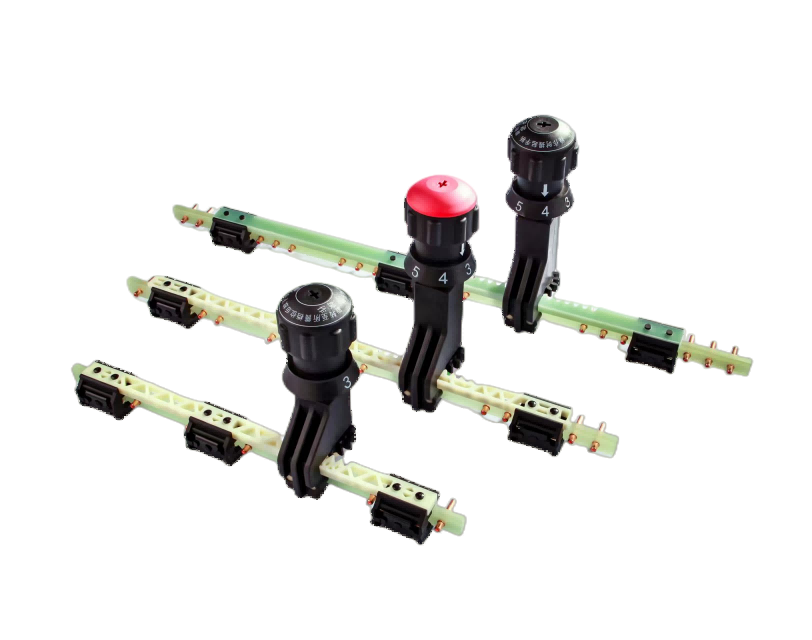
A line-type tap changer is an off-circuit tap-changer used in power transformers. It is primarily employed to manually adjust the winding tap positions when the transformer is de-energized, thereby changing the output voltage .
I. Basic Structure and Working Principle
Line-type tap changer mainly consists of an operating mechanism, insulating rod, drive rod, stationary contacts, and moving contacts . The operating mechanism uses gears to move the drive rod relative to the insulating rod, engaging the moving contacts on the drive rod with the stationary contacts on the insulating rod to achieve tap switching . Each phase is equipped with a set of stationary contacts paired with a moving contact assembly. The moving contacts employ a clip-type design, pressed by springs to bridge adjacent stationary contacts in each phase .
II. Main Characteristics
Structural Advantages: Line-type design is relatively compact, making it suitable for installation on the sidewall or body of the transformer tank. The three-phase leads are linearly arranged, directly corresponding to the transformer windings without increasing the transformer’s overall size .
Insulation Performance: Made of high-quality epoxy cloth board, some models include shielding rings on both sides of the stationary contact group to balance the electric field distribution between contacts, reduce partial discharge, and improve insulation strength .
Ease of Operation: During switching, the tap changer automatically aligns quickly, providing clear tactile feedback. The external operating mechanism has distinct position indicators for easy identification .
III. Application Scenarios
Line-type tap changers are widely used in various transformers within power systems, including distribution transformers, step-down transformers, and step-up transformers. They are primarily applied in 10kV distribution transformers, while high-insulation models can be used in transformers rated above 35kV . They find applications in power generation, transmission, supply, transportation, and industrial/mining sectors .
IV. Advantages
Simple structure, low cost, high reliability
Small size & easy installation
Lightweight operation & clear position indicators


Address:No.27, Binhai South 3 road, Yueqing Economic Development Zone, Wenzhou City,Zhejiang Province,China.