You can know every new products be published here, and witness our growth and innovation.
Date:10-26-2026
A 600A T-body connector does not always leave much room for changes. Then a project calls for one more connection—a 200A loadbreak elbow, perhaps an elbow arrester—and the available interface is the wrong size.
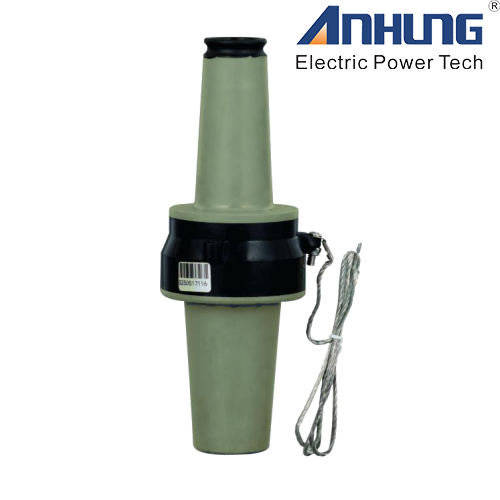
That is where an Integral Deadbreak Bushing earns its place. It fits into the existing 600A deadbreak interface and provides a standard 200A loadbreak port on the other end. The original connection stays in place; the system gains a different connection point.
You may also see it listed as a 600A/200A loadbreak reducing tap plug. Different name, same basic job.
The name can sound more complicated than the part actually is.
On one side, the Integral Deadbreak Bushing has a 600A deadbreak interface. On the other, it has a 200A loadbreak interface. A copper contact carries current through the body, while the EPDM insulation and conductive outer jacket provide the required insulation and shielding.
The 200A port gives the installer somewhere to connect a compatible loadbreak elbow. Depending on the application, it can also accept a 200A insulated protective cap, MOV elbow arrester, or grounding elbow.
There is one point worth clearing up: the bushing does not “reduce” a 600A electrical load to 200A. It adapts the interface. The 600A side remains rated for its intended 600A service, while anything connected to the 200A port must stay within that port’s rating.
That distinction matters during both specification and operation.
Consider a pad-mounted equipment installation with an existing 600A T-body connection. A new 200A branch needs to be added, but replacing the present connector arrangement would mean extra parts and more work on a connection that is otherwise serviceable.
An Integral Deadbreak Bushing offers another route. Install it at the appropriate 600A deadbreak position, then connect the 200A loadbreak elbow to the newly created port. Instead of rebuilding the junction, the installer adapts it.
The same approach can be used when the requirement is not another cable at all. A project may call for an elbow arrester, or simply a properly insulated cap on a spare 200A port. In each case, the useful part is not just the current rating—it is the change in interface.
For retrofit work, that can be a tidy solution. It is not, however, a universal substitute for every connector replacement. The equipment bushing, T-body, adapter, and elbow still need to be checked as a complete assembly.
A 15kV Integral Deadbreak Bushing is more than a shaped piece of rubber with a contact inside.
The insulating body is commonly made from peroxide-cured EPDM. Around it, a conductive EPDM jacket provides external shielding. The product datasheet specifies a jacket meeting the applicable requirements of IEEE Std 592, while the connector design is manufactured to IEEE Std 386 requirements.
Inside, the copper contact does the heavy electrical work. Its shape, surface condition, and fit affect how the two interfaces perform after assembly. An arc-extinguishing chamber is incorporated at the loadbreak end, and a grounding eye provides the shield connection point.
Small installation details matter here. Contamination on a mating surface, the wrong lubricant, or an incomplete connection can undo the benefit of a well-made component. The supplied cleaning materials, silicone lubricant, wrench, and instruction sheet are therefore part of the installation, not packing-list filler.
For the 15kV, 600A/200A design, the continuous-current ratings are 600A rms at the 600A interface and 200A rms at the 200A interface. The listed maximum ratings are 8.3kV phase-to-ground and 14.4kV phase-to-phase, with a 95kV BIL.
The short-time current ratings are not identical at both ends. That is another reason to read the table rather than specify from the product name alone. The 0.17-second rating is 10kA symmetrical for the 200A interface and 25kA symmetrical for the 600A interface; the listed three-second rating is 3.5kA symmetrical.
Production testing is just as relevant as the headline figures. The datasheet calls for AC withstand and partial-discharge tests on each body before delivery. Periodic X-ray analysis and individual traceability add further checks on what cannot be seen from the outside.
Adding a loadbreak port does not change how the 600A side may be operated. A deadbreak interface must not be separated under load. The loadbreak capability belongs to the appropriately rated 200A connection, not to every part of the assembly.
Before installation, the crew should confirm voltage class, interface compatibility, conductor and accessory requirements, and the intended operating sequence. Installation and switching belong with qualified personnel following the equipment instructions and site safety procedures.
Used within those limits, an Integral Deadbreak Bushing solves a very specific problem without unnecessary drama: a 600A deadbreak position becomes a usable 200A loadbreak connection. For an existing T-body installation that needs one more tap, an arrester, or a capped spare port, that simple mechanical change can make the whole connection layout easier to work with.


Address:No.27, Binhai South 3 road, Yueqing Economic Development Zone, Wenzhou City,Zhejiang Province,China.