You can know every new products be published here, and witness our growth and innovation.
Date:10-05-2026
In medium voltage distribution systems, a parking bushing is not usually the component that gets the most attention. But for systems using loadbreak elbow connectors, it has an important role when an energized cable connection needs to be temporarily or permanently parked.
So, what exactly is a parking bushing, and where does it fit into a medium voltage distribution system?
A parking bushing provides a designated interface for a loadbreak elbow when the elbow is not connected to its normal operating position. The bushing helps keep the cable connection insulated and shielded while the elbow is parked.
For medium voltage applications, the design of the parking bushing matters because the connection still needs to maintain the required electrical insulation and shielding during this parked condition.
What Does a Parking Bushing Do?
A parking bushing is designed to work with a suitably rated loadbreak elbow.
When a loadbreak elbow is removed from its normal connection point, it cannot simply be left exposed. The elbow needs a suitable parking position that maintains the required level of insulation and shielding.
This is where the parking bushing comes in.
A properly matched parking bushing provides an insulated and fully shielded connection point for the elbow. Depending on the system design, it can be used for either temporary or permanent parking of a loadbreak elbow.
For this reason, parking bushings are commonly found in medium voltage equipment and cable accessory applications where loadbreak connections are used.
How Does a Parking Bushing Work With a Loadbreak Elbow?
The basic arrangement is relatively straightforward.
The parking bushing is mounted on the equipment side, while the loadbreak elbow is connected to the bushing when it needs to be parked.
The two components need to have compatible electrical and mechanical ratings. A properly matched combination provides a fully shielded interface rather than leaving the elbow connection exposed.
For applications involving medium voltage cable accessories, this compatibility is particularly important. Voltage class, current rating and interface design all need to be considered when selecting the appropriate components.
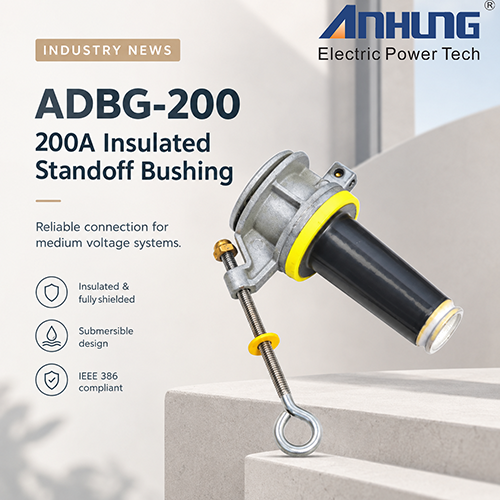
ADB G-200: 200A Insulated Standoff Bushing
For example, the ADBG-200 is a 200A insulated standoff bushing designed for medium voltage applications.
It uses peroxide-cured EPDM insulation and provides an insulated, fully shielded, submersible connection. The design also incorporates a stainless steel eyebolt and base bracket for mounting on an apparatus parking stand.
The ADBG-200 is designed for use with loadbreak elbows that meet the corresponding requirements of IEEE Standard 386.
The product is available in:
15 kV
25 kV
35 kV
with a 200A current rating.
The corresponding references are:
A DBG-15/200 – 15 kV Standoff Bushing
A DBG-25/200 – 25 kV Standoff Bushing
A DBG-35/200 – 35 kV Standoff Bushing
This range allows the same basic standoff bushing design to cover different medium voltage classes.
Why Is EPDM Used for a Parking Bushing?
The insulating material is one of the key parts of a medium voltage bushing.
The ADBG-200 uses peroxide-cured EPDM rubber for its insulation. The material forms part of the insulated and shielded structure of the bushing.
For medium voltage cable accessories, the insulation system has to work together with the overall shielding and interface design. It is therefore not simply a matter of selecting a material with good insulation properties; the complete component needs to be designed around its intended electrical application.
What Should You Check When Selecting a Parking Bushing?
Choosing a parking bushing is not only about looking at the product name.
Several basic parameters should be checked before selecting a model.
1. Voltage class
The parking bushing needs to match the voltage class of the application.
For the ADBG-200 series, the available voltage classes are 15 kV, 25 kV and 35 kV.
2. Current rating
The current rating also needs to match the associated equipment and loadbreak elbow.
The ADBG-200 series is rated at 200A.
3. Interface compatibility
The bushing should be compatible with the loadbreak elbow being used in the system. A correct electrical rating alone does not guarantee that two components are suitable for connection.
4. Insulation and shielding
For medium voltage applications, maintaining an insulated and fully shielded connection is an important part of the component design.
The ADBG-200 is designed as an insulated, fully shielded and submersible connection.
5. Applicable standards
The applicable industry standard should also be checked before selecting a parking bushing.
The ADBG-200 meets the requirements of IEEE Standard 386.
Quality Control of the ADBG-200
For medium voltage cable accessories, product testing is an important part of manufacturing.
According to the product specifications, each ADBG-200 body is tested for AC withstand and partial discharge before delivery. The product also undergoes periodic X-ray analysis, and QR coding is used for traceability.
These quality-control steps are intended to help verify the consistency of the product before it is supplied for field applications.
Parking Bushing vs. Other Medium Voltage Bushings
One common source of confusion is that “bushing” is a broad term.
Not every bushing in a medium voltage system serves the same purpose.
A parking bushing is specifically associated with the parking of a suitably rated loadbreak elbow. Its design therefore needs to take into account the elbow interface, insulation, shielding and the electrical requirements of the application.
This is why it is better to select a parking bushing based on the complete connection system rather than treating it as an isolated component.
Final Thoughts
A parking bushing may be a relatively small component in a medium voltage distribution system, but it provides a defined and insulated parking point for loadbreak elbow connections.
When selecting one, the key points to check are voltage class, current rating, interface compatibility, insulation and shielding, and applicable standards.
For applications requiring a 200A insulated standoff bushing, the ADBG-200 is available in 15 kV, 25 kV and 35 kV versions and is designed in accordance with IEEE Standard 386 requirements.


Address:No.27, Binhai South 3 road, Yueqing Economic Development Zone, Wenzhou City,Zhejiang Province,China.