You can know every new products be published here, and witness our growth and innovation.
Date:09-08-2026
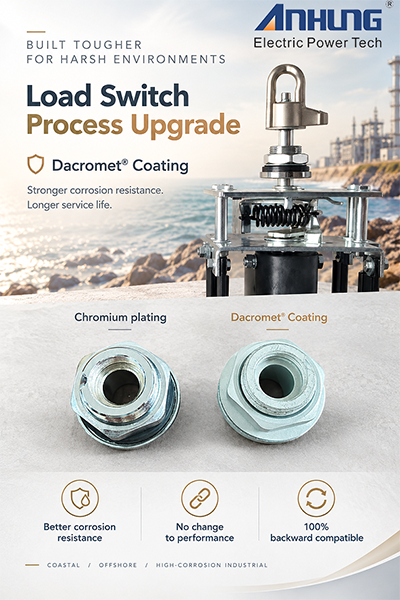
Stop with the speculation—here’s the actual deal on our load switch series upgrade. Instead of traditional chrome plating, we’re now applying a Dacromet coating on key iron-based fixed sleeve components. That’s the only change. Price, size, performance, and warranty—every other spec stays locked. No model number shifts. No dimension tweaks. No hidden surprises.
I’ve sat through enough factory meetings where suppliers quietly roll out “improvements” that break site compatibility. This one is different. And I want to walk you through what we actually did, why it matters, and what stays exactly as before—in three parts.
Every current load switch model in our portfolio gets this surface treatment update. But here’s the key: model codes, technical parameters, and structural drawings remain 100% identical.
If you’ve already done your selection, layout, or panel design—keep using those files. No revision needed. No requalification.
I’ve been on the procurement side before, and I know the first question is always: “Will this mess up my existing setup?” The answer is no. This is a like-for-like swap at the coating level only.
Why the switch? Not for show. Two clear operational gains:
Corrosion resistance takes a big leap.
Dacromet handles salt spray and high humidity far better than chrome.
I recall an offshore wind project a couple of years back—chrome parts on those outdoor switches started showing rust within 24 months. Maintenance costs ballooned. After this upgrade, we expect that kind of exposure to hold up significantly longer. Ideal for coastal plants, chemical facilities, or any site with aggressive atmospheres.
Hydrogen embrittlement? Gone.
Chrome plating carries that inherent risk—high-strength parts can develop micro-fractures over time. Dacromet doesn’t have that issue. It’s a straight safety improvement.
For outdoor gear that runs for years, that’s not a minor footnote—it’s a major reliability factor.
And just to be absolutely clear: electrical ratings, mounting dimensions, torque specs, interface fit—none of those change.
The new parts are fully backward compatible with old ones. Your warehouse stock of existing units and the gear already bolted in the field—both work seamlessly with the new supply. No adapters, no retrofit kits, no on-site rework.
This is where I think the decision really shows good faith:
In my years dealing with engineering and procurement, it’s rare to see a manufacturer voluntarily upgrade a process, eat the cost, and still guarantee full interchangeability. That’s not marketing talk—that’s practical respect for your project schedules and site operations.
This iteration is meant to give you a tougher switch for harsh outdoor duty, with zero disruption to your design, installation, or maintenance routine.
If you’re currently specifying these load switches—or just have questions about how the coating performs in your specific environment—reach out to technical support or your sales contact. They’ll give you site-specific data, not generic fluff.
All in all, this is one of those rare “clean” upgrades. Better product, no headache for the customer. That’s how it should be.
1. Only change: Dacromet coating replaces chrome on iron-based fixed sleeves.
2. All models covered, but model/performance/dimensions/warranty unchanged.
3. Full mechanical and electrical interchangeability with previous versions.
4. Price unchanged. Old-version supply available on request while stock lasts.
5. Main benefits: higher corrosion resistance + zero hydrogen embrittlement risk.
6. No adaptation work needed on your side—direct drop-in replacement.


Address:No.27, Binhai South 3 road, Yueqing Economic Development Zone, Wenzhou City,Zhejiang Province,China.