You can know every new products be published here, and witness our growth and innovation.
Date:01-30-2026
I. Functional Purpose
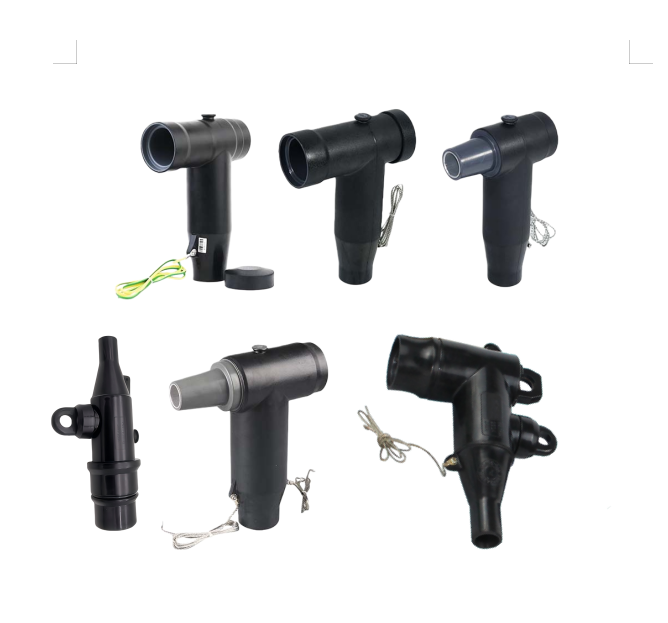
Separable Connector : Emphasizes separable connection functionality, facilitating maintenance, testing, and reconfiguration of equipment without requiring full system shutdowns .
Cable Termination : Emphasizes permanent, fixed connection functionality, ensuring reliable and long-term operation at the endpoints of a cable run where it connects to other electrical equipment like transformers or switchgear .
Tee Connector : Emphasizes branching connection functionality, enabling the creation of branch lines from a main cable circuit, often within cable distribution cabinets or ring main units .
2. Structural Characteristics
Separable Connector : Utilizes a plug-in (plug-and-socket) structure, designed for repeated engagement and disengagement. Common designs include Elbow Connectors (90-degree bend) and straight In-Line Connectors .
Cable Termination : Typically employs a fixed installation structure, often intended for one-time, permanent installation using methods such as crimping or compression .
Tee Connector : Features a T-shaped sleeve structure, providing one input and two output paths to achieve the branching function. It is often a pre-molded, fully insulated assembly .
3. Application Scenarios
Separable Connector : Suitable for equipment inlet/outlet connections requiring frequent maintenance or replacement, such as connections to ring main units, pad-mounted transformers, or cable distribution cabinets where reconfiguration is needed .
Cable Termination : Applied for fixed connections at the start and end points of cable lines, such as the terminations inside switchgear, control panels, or on transformer bushings .
Tee Connector : Used for mid-circuit branch connections in cable lines, commonly found in cable branching boxes to supply power to different loads from a single feeder .
4. Voltage Level Applications
Separable Connector : Primarily applied at 10kV and 35kV voltage levels in medium-voltage distribution networks .
Cable Termination : Covers a wide range from 1kV to 220kV and across multiple voltage levels, applicable in both low-voltage and high-voltage systems .
Tee Connector : Mainly used at 10kV and 35kV voltage levels for medium-voltage distribution applications .
When selecting among these cable accessories, the choice should be based on specific project requirements and practical conditions :
For frequent maintenance and reconfiguration: Prioritize Separable Connectors (e.g., Elbow Connectors, In-Line Connectors).
For permanent fixed connections at cable line endpoints: Choose the appropriate Cable Termination (e.g., Cold Shrink Terminations, Heat Shrink Terminations).
For creating branch connections in the middle of a cable run: Select a Tee Connector.
For high-voltage applications (e.g., above 35kV): Select Cable Terminations rated for the corresponding voltage level.
For harsh environmental conditions: Choose fully insulated, fully sealed, and shielded types of either Separable Connectors or Cable Terminations to ensure reliability .
In summary, Separable Connectors, Cable Terminations, and Tee Connectors are common cable accessories in power systems, each with distinct purposes and characteristics. Selection and use must be determined based on specific engineering requirements and practical conditions to ensure.


Address:No.27, Binhai South 3 road, Yueqing Economic Development Zone, Wenzhou City,Zhejiang Province,China.