You can know every new products be published here, and witness our growth and innovation.
Date:01-06-2026
I. Main Types and Application Scenarios
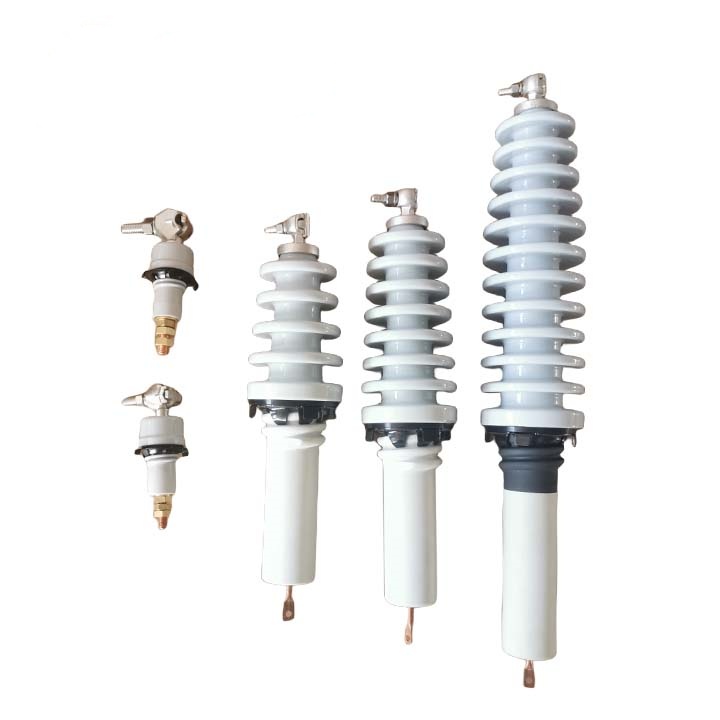
ANSI bushings can be classified into three types based on their functions and structures, precisely matching the typical requirements of the North American power grid:
1. ANSI post-type ceramic bushing (ANSI Post-Type Ceramic Bushing)
Application: Substation busbar support, transformer outgoing line insulation, high-voltage busbar isolation in distribution cabinets;
Features: Vertically installed, with ANSI standard flanges at the top (such as 4-hole/6-hole flanges, with hole spacing in accordance with ANSI B16.5), and connection terminals at the bottom compatible with common rectangular busbars or cable connectors in North America;
Typical scenarios: 10kV/35kV transformers in urban power grids of North America, outdoor GIS (Gas Insulated Switchgear) busbar support.
2. ANSI wall-penetrating ceramic bushing (ANSI Wall-Penetration Ceramic Bushing)
Application: High-voltage lines passing through building walls, metal cabinets (such as distribution rooms, factory workshop partitions);
Features: The middle part is the wall-penetrating section (length customized according to the thickness of the wall, in accordance with ANSI C37.34 length tolerance), both ends with waterproof flanges to prevent water vapor penetration on both sides of the wall;
Typical scenarios: 138kV high-voltage cables passing through walls in industrial buildings, 10kV incoming line bushings in commercial buildings.
3. ANSI transformer ceramic bushing (ANSI Transformer Ceramic Bushing)
Application: Connection of winding leads of oil-immersed transformers and dry-type transformers to the external power grid;
Features: Built-in capacitive voltage equalization structure as per ANSI standards (reducing internal electric field concentration), connection terminals with pressure relief valves (automatically releasing pressure in case of faults), compatible with the “top-out” or “side-out” layout commonly used in North American transformers;
Typical scenarios: 500kV ultra-high voltage transformers in the North American power grid, 35kV box-type transformers in wind farms.
II. Core Advantages of ANSI Bushings
1. Standardized interchangeability: Dimensions and interfaces fully comply with ANSI standards, allowing direct replacement of the same specification bushings in existing equipment in the North American market, reducing renovation costs;
2. Rigorous reliability: Through the “full type test” as per ANSI requirements (such as 1000 mechanical vibration tests, thermal cycling tests), the lifespan can reach over 30 years, meeting the “low maintenance” requirements of the North American power grid;
3. Multi-scenario adaptability: Covers all voltage levels from low-voltage distribution to ultra-high voltage transmission, taking into account typical North American environments such as heavy pollution outdoors, high indoor temperatures, and coastal salt fog;
4. Compliance guarantee: Complies with North American UL certification (Underwriters Laboratories), CSA certification (Canadian Standards Association), enabling direct entry into the North American market for sales.
III. Summary
ANSI bushings are the result of the deep integration of “ceramic material advantages” and “North American standard system”. They not only possess the inherent insulation, weather resistance, and corrosion resistance characteristics of ceramic bushings, but also through the standardized design of ANSI standards, solve the “compatibility” and “reliability” pain points of cross-border projects. They are the preferred solution for high-voltage insulation components in the North American power grid and overseas projects of North American enterprises. Whether it is new substations or renovation of old power grids, ANSI ceramic bushings can ensure the long-term stable operation of the power system with standardized performance.


Address:No.27, Binhai South 3 road, Yueqing Economic Development Zone, Wenzhou City,Zhejiang Province,China.