You can know every new products be published here, and witness our growth and innovation.
Date:03-23-2026
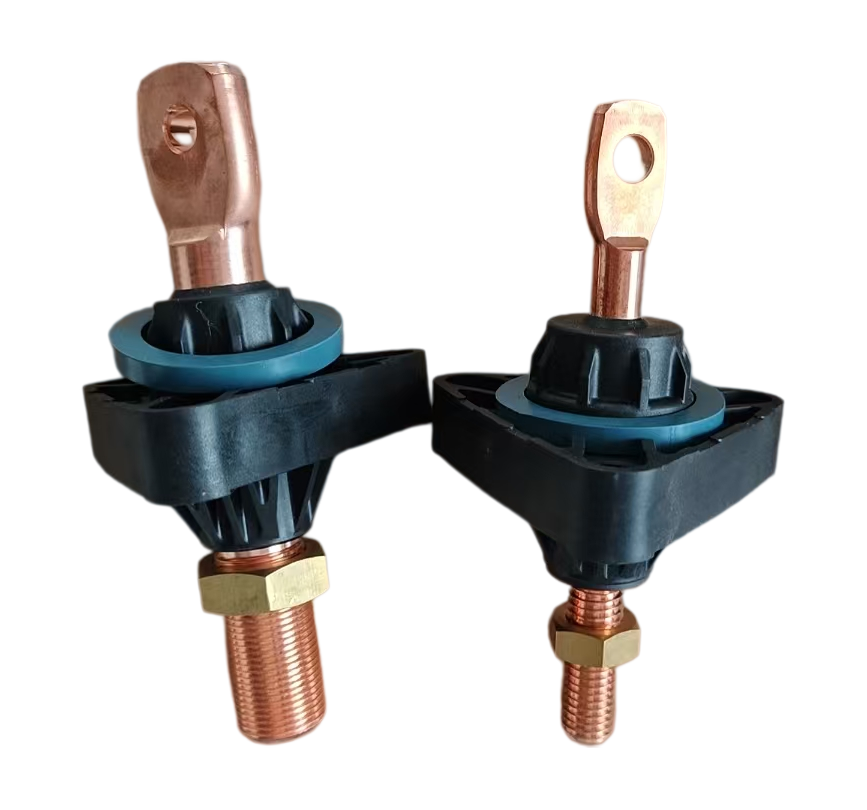
Q1: What is the main function of this 1.2KV 1200A triangular transformer bushing?
A1: This bushing is the core component that connects the low-voltage windings inside the transformer to the external low-voltage distribution system (such as busbars or cables). It plays a crucial role as a physical and electrical interface. Its main functions include:
Conductive function: As a conductive path with a rated current of up to 1200 amperes. It efficiently and with low loss transmits large amounts of electrical energy.
Insulating function: Provides sufficient insulation for live conductors to ground (oil tank) and the same insulation. Ensures safe operation at the 1.2kV voltage level.
Sealing function: Its sealing structure is the key barrier of the transformer oil tank, permanently preventing the leakage of internal insulating oil. And it isolates external moisture and contaminants from invading, ensuring the long-term health of the transformer’s internal insulation system.
Connecting function: The terminal design at the outlet end is convenient for a stable and standard electrical connection with the external low-voltage system.
Q2: What are the distinctive features of the “triangle” connection design of the product? How is it manifested in actual installation?
A2: The “triangle” design specifically refers to this bushing being suitable for applications where the low-voltage winding of the transformer is connected in a triangle (Delta) configuration. Its distinctive features are as follows:
Space layout: The terminal (such as a flat plate or threaded terminal) of each of the three (one group) bushings usually conforms to the electrical connection requirements of the triangle connection method. The design has specific spatial angles (such as 120 degrees or the angle determined based on the installation surface) and center spacing. This facilitates direct, compact, and standardized connection with the copper bars or busbars arranged in a triangle pattern, avoiding additional transition bends and reducing connection impedance and installation space.
Phase identification: The bushings usually have clear and permanent phase markings (such as A, B, C or L1, L2, L3). This ensures accurate on-site wiring and compliance with the phase sequence requirements of the triangle connection method.
In actual installation, simply follow the product drawings and markings, and connect the external low-voltage busbar or cable to the terminals of the three bushings, to complete the standard triangle outlet connection, which is efficient and reliable.
Q3: How does the product perform in terms of temperature rise and heat dissipation under long-term high current (1200A) operation?
A3: To ensure safe and stable operation at the rated current of 1200A, this product has undergone multiple optimizations in design and materials:
Large cross-section high-conductivity materials: The conductive rods (tubes) are made of large cross-section high-purity copper, effectively reducing the DC resistance and reducing heat generation at the source.
Optimized connection structure: The connection points between the conductor and the terminal block use advanced crimping, welding or integrated designs. And possibly supplemented with anti-oxidation coatings (such as tin plating, silver plating) to ensure extremely low and stable contact resistance.
Enhanced heat dissipation design: Depending on the model, it may use built-in heat dissipation channels, external heat sinks (wings), or utilize the insulation material itself (such as epoxy resin with good thermal conductivity) to assist in heat dissipation, effectively increasing the heat dissipation area and optimizing the heat conduction path.
Strict verification: During the design and finalization stage and during the factory sampling tests, the product undergoes strict temperature rise tests to verify its temperature rise value under the rated current (even overload current). Ensuring that it complies with and exceeds the requirements of national standards (such as GB/T 4109) and international standards (such as IEC 60137), guaranteeing that the long-term operating temperature remains within the safe range.


Address:No.27, Binhai South 3 road, Yueqing Economic Development Zone, Wenzhou City,Zhejiang Province,China.